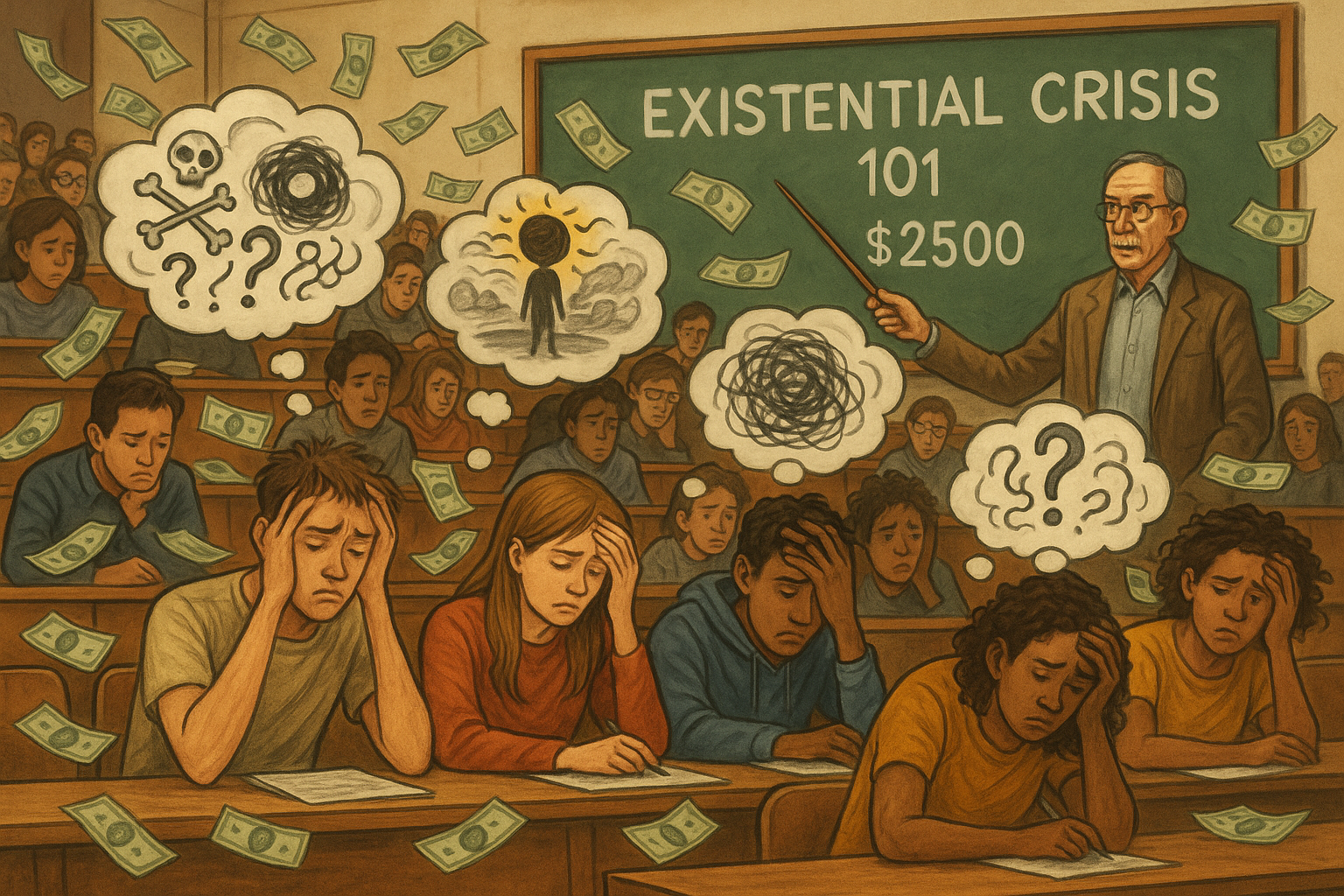
In a groundbreaking move that has left both students and economists bewildered, universities across the country have introduced a new “Existential Crisis” surcharge to their tuition fees. This development follows a recent study by the Institute for Higher Learning Economics, which suggests that undergraduates’ increasing sense of cosmic dread is negatively impacting their academic performance. The surcharge, set at an average of $300 per semester, is intended to offset the costs of additional mental health services and philosophy seminars now deemed necessary by university administrators.
Dr. Raymond Kettle, an educational psychologist with the Bureau of Student Affairs, explained that the surcharge is a pragmatic response to a growing trend. “We found that students are increasingly grappling with questions about the futility of existence and their place in a vast, indifferent universe,” Kettle stated, “and this has led to a notable decline in both GPA scores and attendance at pep rallies.” The surcharge will fund a new department of existential management, offering courses such as “Advanced Nihilism” and “Postmodern Despair: A Practical Approach.”
The decision has sparked a range of reactions from the academic community. While some faculty members hailed it as a necessary adaptation to the modern educational landscape, others worried about the potential increase in dropout rates. A recent poll conducted by the National Educational Oversight Board found that 67% of students felt the fee was “yet another abyss to stare into,” while 23% anticipated it might provide some form of “existential closure.”
As universities begin to implement this fee, administrators are also considering additional surcharges for “Digital Fatigue” and “Climate Anxiety.” At press time, students at several major institutions were reportedly forming support groups to discuss the implications of their newfound awareness, though many attendees left the gatherings with an even deeper sense of ennui.
 English
  Portuguese
Leave a Reply