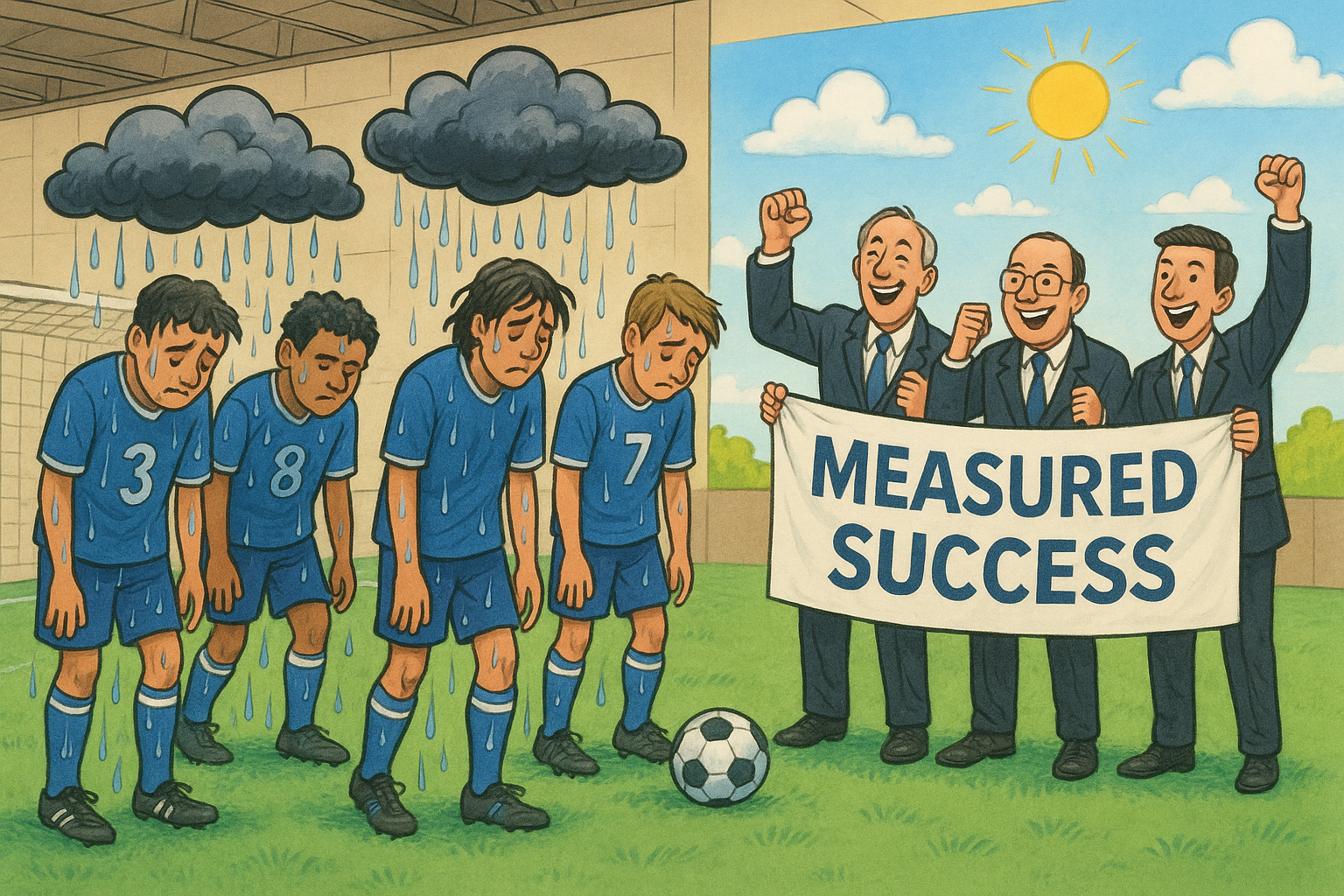
In an unprecedented move, Newcastle officials have attributed their recent lackluster indoor performance to the city’s unpredictable weather patterns, despite the events taking place entirely inside climate-controlled arenas. The announcement came after a comprehensive three-month study conducted by the Newcastle Atmospheric Dynamics and Indoor Recreation Committee (NADIRC), which concluded that external weather conditions have a “psychosomatic influence” on indoor activities, affecting both morale and spatial orientation.
Dr. Harold Bennet, lead researcher at NADIRC, explained that the mere knowledge of inclement weather outside can trigger a “mental fog” among participants, akin to Seasonal Affective Disorder but localized entirely within one’s psyche. “It’s a groundbreaking discovery,” claimed Dr. Bennet, “We’ve found that even the mention of rain in a weather forecast can lead to decreased performance metrics in environments as insulated as a squash court.” The findings have sparked a wave of interest from various indoor sports leagues, eager to understand how these insights might explain their own sporadic failures.
In light of these revelations, Newcastle’s indoor sports committee has labeled the recent poor performances as “a measured success,” citing the opportunity to explore innovative training methods involving weather simulation chambers. These facilities, currently under construction, are expected to replicate the exact atmospheric conditions of a typical Newcastle autumn day to better prepare athletes for the psychological challenges posed by real-time weather data. City officials believe this approach will not only enhance performance but also bolster the city’s reputation as a leader in cutting-edge sports psychology.
At press time, Newcastle city planners have begun developing a pilot program to implement weather-responsive indoor lighting systems, which will dim and brighten in accordance with cloud cover and barometric pressure, respectively, in an effort to acclimate residents to the ever-present influence of nature’s whims.
 English
  Portuguese
Leave a Reply