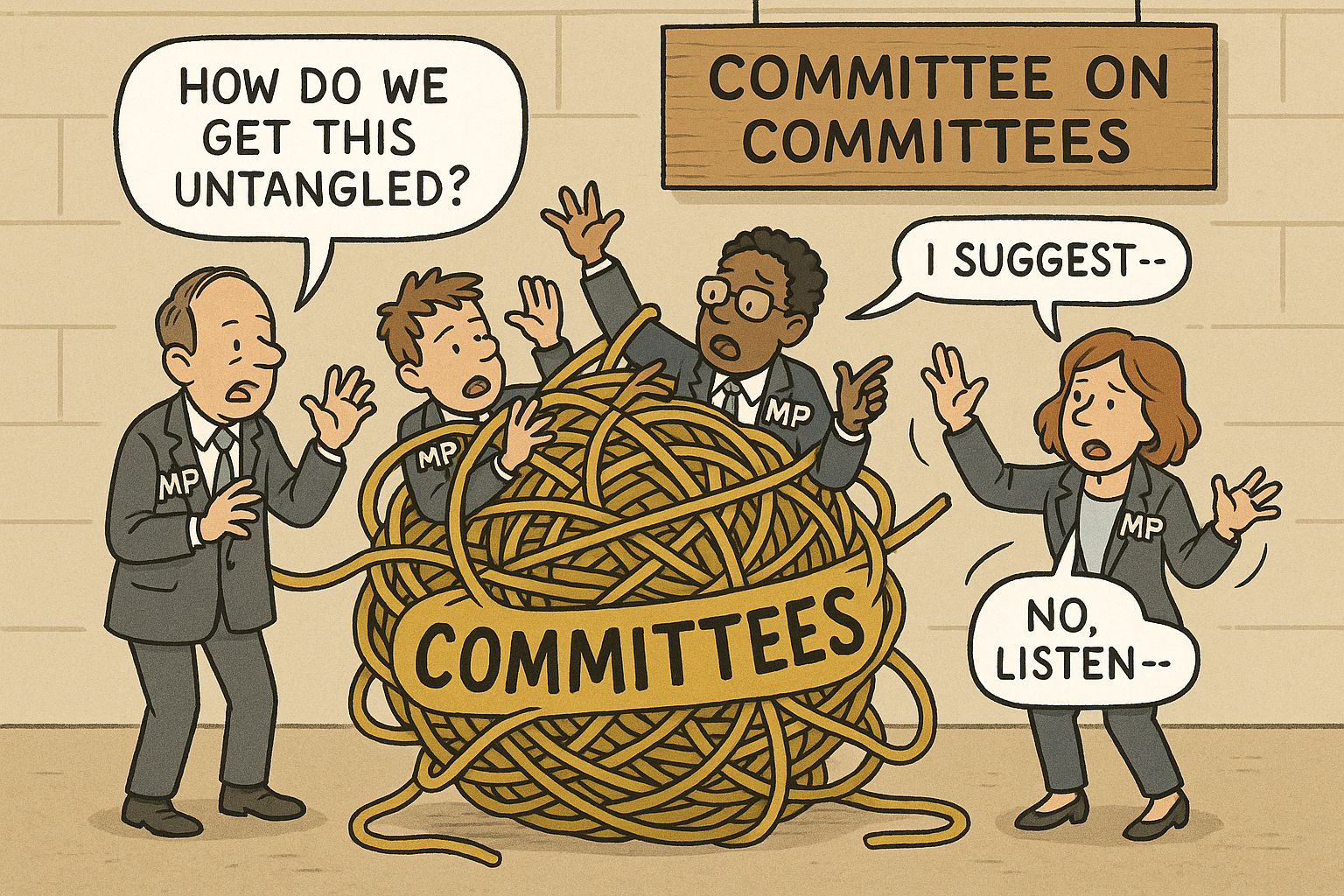
In a bold move to address the burgeoning issue of committee overload within the government, Members of Parliament have proposed the creation of additional committees specifically tasked with investigating the inefficiencies of existing committees. The proposal, which has been met with enthusiastic nods and strategic murmurs of approval in Westminster, suggests that the new committees will initially focus on the structural analysis of current committee redundancies before exploring potential sub-committee formations to handle their own exponential growth.
The proposal emerged after a comprehensive 18-month study by the Parliamentary Bureau of Oversight, Inefficiency, and Redundancy, which concluded that existing committees are operating at a mere 12% efficiency rate. Dr. Geraldine Farnsworth, a leading expert in bureaucratic navigation, praised the initiative as “a forward-thinking approach to managing institutional bloat.” She added, “We have long needed a more nuanced layer of oversight to ensure each committee is held accountable to its mandate of oversight.”
The plan outlines a phased implementation, starting with the establishment of the Committee Review Committee, which will be responsible for drafting a framework for the Committee on Committee Efficiency. This will be followed by the Committee Efficacy Evaluation Task Force, charged with conducting a series of pilot studies to test the feasibility of future committees. The initiative has sparked a surge of excitement among parliamentary aides, who anticipate a significant uptick in employment opportunities within the sub-committee support sector.
Critics, however, remain skeptical about the logistical implications of such a plan, citing concerns about potential recursive cycles of committee inception. At press time, sources confirmed that a new sub-committee had already been formed to address the unexpected popularity of the initial proposal, with its first meeting scheduled to determine the necessity of its existence.
 Portuguese
  English
Deixe um comentário